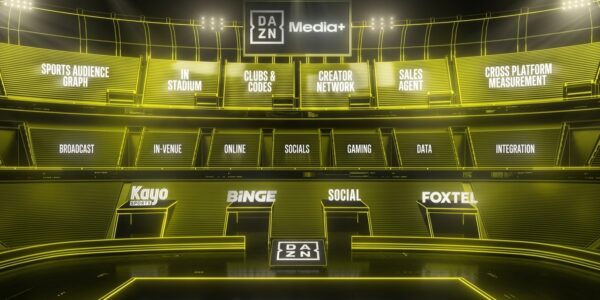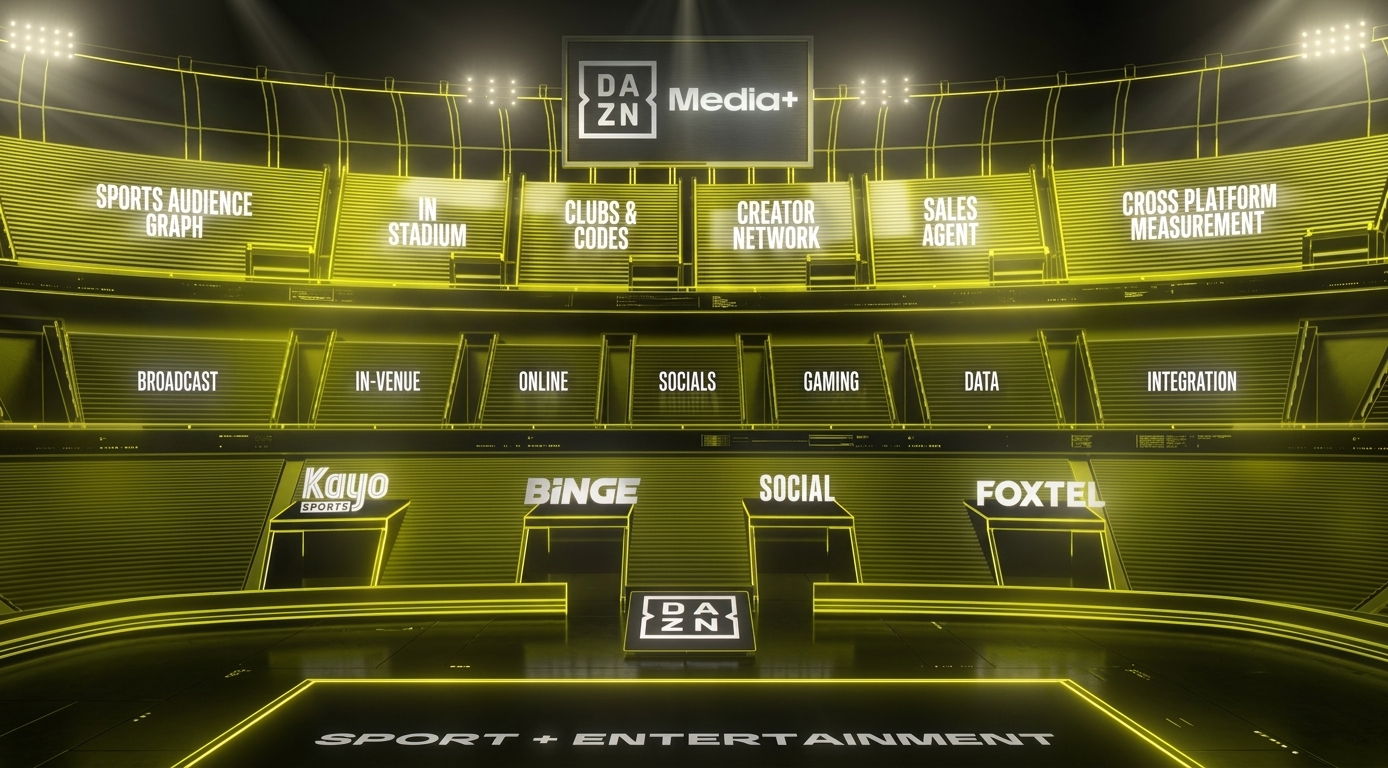
We spent a morning at a media upfront recently, the event where Foxtel Media formally became DAZN Media+ and left with pages of notes that had surprisingly little to do with the new name on the door. A proprietary audience database built from years of first-party viewing data. An AI-powered trading tool for buying video inventory. A partnership for independent, cross-platform measurement. In-stadium advertising technology stitched to what happens on screen. A creator ecosystem sitting alongside traditional broadcast rights.
Sitting in that room, none of it felt like a story about one platform’s rebrand. It felt like a fairly precise snapshot of where media is heading generally, and it’s the kind of thing worth pulling apart in the open, not because every brand needs a sports audience graph, but because the underlying shifts show up wherever we look across retail media, streaming, out-of-home and social. Four of them seemed worth sitting with, and worth raising with the brand leaders we work alongside.
The audience no longer lives on one platform
The pitch wasn’t “watch our channel.” It was content and experience spanning streaming, free-to-air-style aggregation, physical venues and creator content, one audience moving fluidly between a stadium, a stream and a highlights clip on someone’s phone. That’s not unique to sport. A retail brand’s customer moves between a retail media network, a marketplace, a physical store and a creator’s unboxing video in the same week. The old habit of planning channel by channel assumes boundaries that audiences have mostly stopped respecting.
The open question for a brand leader isn’t “which channel should get the budget” so much as “what does this audience’s actual path look like, and are we set up to see it as one path rather than four separate ones?”
First-party data is becoming the product, not just the fuel
Building a database from six million data points isn’t a measurement footnote, it’s being positioned as the core asset, arguably more valuable than the content rights themselves. That mirrors what’s happening across retail media, banking media networks and telco data businesses: the audience data a company already holds is being packaged and sold as a distinct commercial layer.
For a brand buying media, that raises a genuinely open question rather than a settled one: when a platform offers rich, proprietary audience insight, how much of that do you take at face value, and how much do you want verified by someone with no stake in the answer? It’s a question we find ourselves asking platform partners more directly than we used to, and reasonable people land in different places on it, which is exactly why it’s worth asking rather than assuming the answer.
Buying media is starting to involve less human negotiation
An “agentic” sales tool for premium inventory is a small line in a long list of announcements, but it points at something bigger, media buying and selling increasingly mediated by AI on both sides of the transaction, not just in optimisation after the fact. That’s efficient. It’s also a shift in where judgement sits, and how much of it a brand is comfortable delegating versus keeping in human hands.
This isn’t a case for or against automation, it’s simply happening faster than most buying processes and governance structures have caught up with, which makes it a reasonable thing for a brand leader to have a point of view on internally, even if the market hasn’t settled on one.
Independent measurement is becoming a selling point, not an afterthought
It was telling, sitting there, that a platform announcing its own proprietary data trove felt the need to pair it with an independent measurement partnership in the same breath. That tension, platforms wanting to prove the strength of their own audience while also being seen to submit it to outside scrutiny, is playing out across Australian media more broadly, television measurement included. It suggests the market is deciding that owned data alone isn’t enough of a currency anymore; it needs a neutral referee attached to it to be fully trusted.
A thought, not a verdict
None of this is offered as a conclusion about what brands should do differently on Monday. It’s more that one morning at one upfront turned out to be a useful lens on four things already reshaping media more broadly: audiences that ignore channel boundaries, data becoming a tradeable asset in its own right, buying decisions increasingly shared with machines, and measurement needing outside validation to hold its value. It’s the discussion we’re planning to keep having with the brand leaders we work with, worth raising in your next media conversation too, even if nobody in the room has a firm answer yet.